


An independent 38-room hotel owner on the Algarve coast collected three proposals from three different marketing agencies last spring. One quoted a flat monthly retainer. One quoted a percentage of the revenue it claimed to influence. One quoted a lower base fee plus a performance bonus tied to direct booking growth. All three claimed to cover “full-service digital marketing.” None of the three numbers were comparable to each other, because none of the agencies were pricing the same scope of work the same way. The owner ended up choosing the cheapest-looking option on paper, which turned out to exclude paid media spend entirely — a detail buried in a footnote, not the headline number.

That confusion is the norm, not the exception. Hotel marketing agency pricing varies less because agencies disagree about what a hotel needs, and more because the pricing model itself changes what a number actually represents. Before comparing any two quotes, it helps to know which model each one is built on.
The three pricing models, and what each one actually covers
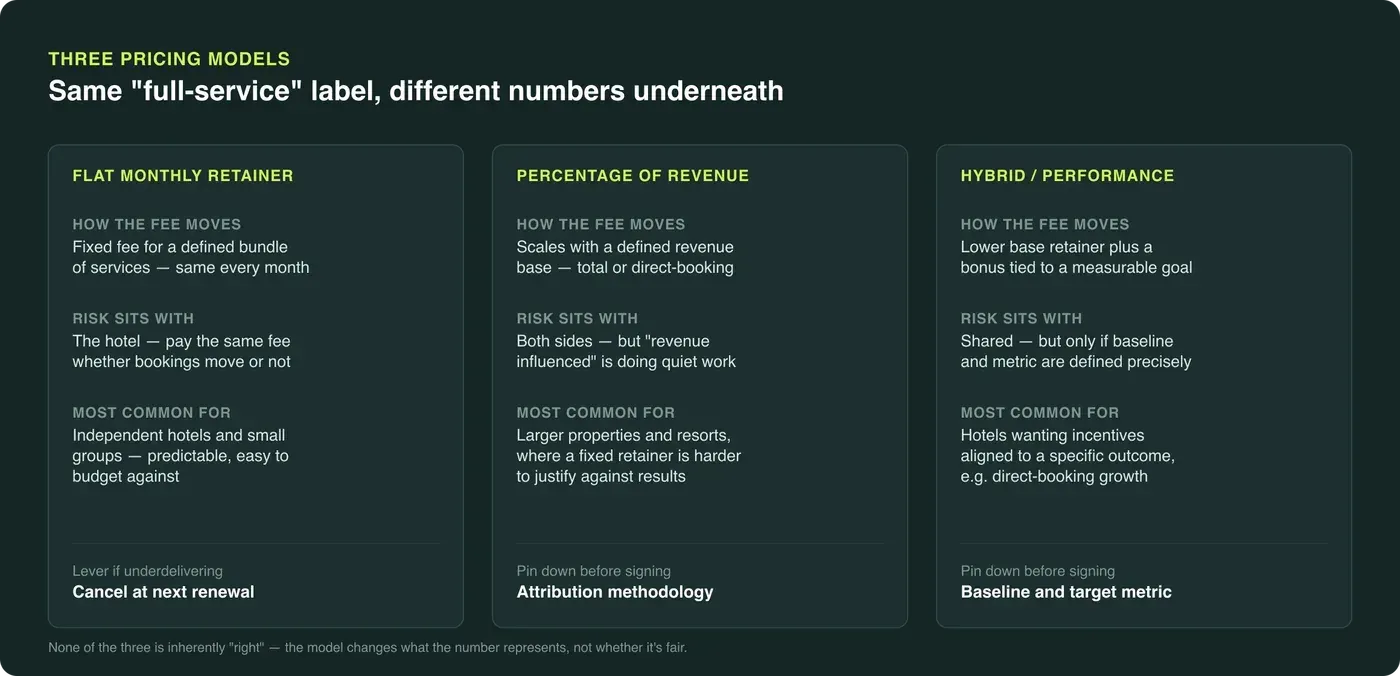
Flat monthly retainer. A fixed fee, typically covering a defined bundle of services — some combination of SEO, content, paid media management, and reporting — regardless of how the property performs that month. This is the most common model for independent hotels and small groups because it is predictable and easy to budget against. The risk sits entirely with the hotel: pay the same fee whether bookings move or not, and if the agency underdelivers, the only lever is cancelling the contract at the next renewal point.
Percentage of revenue. The agency’s fee scales with a defined revenue base, usually either total room revenue or specifically the direct-booking revenue the agency can plausibly claim credit for. This model is more common with larger properties and resorts, where the absolute dollar figures involved make a fixed retainer harder to justify against results. The structural problem is attribution: if the fee is tied to “revenue influenced,” the definition of “influenced” is doing a lot of quiet work, and it is worth pinning down in writing before signing, not assuming it means what it sounds like it means.
Hybrid or performance-based. A lower base retainer plus a bonus or scaled fee tied to a specific, measurable outcome — direct booking revenue growth against a baseline, a target reduction in OTA dependency, or a cost-per-acquisition ceiling. This model aligns incentives better than either of the first two, but only if the baseline and the metric are defined precisely enough that both sides agree, months later, on whether the target was actually hit.
None of these models is inherently the “right” one. A flat retainer that fully covers paid media spend can cost more in total than a percentage-of-revenue deal that excludes it — the model tells you how the number moves, not whether the number is fair.
What actually drives the price up or down
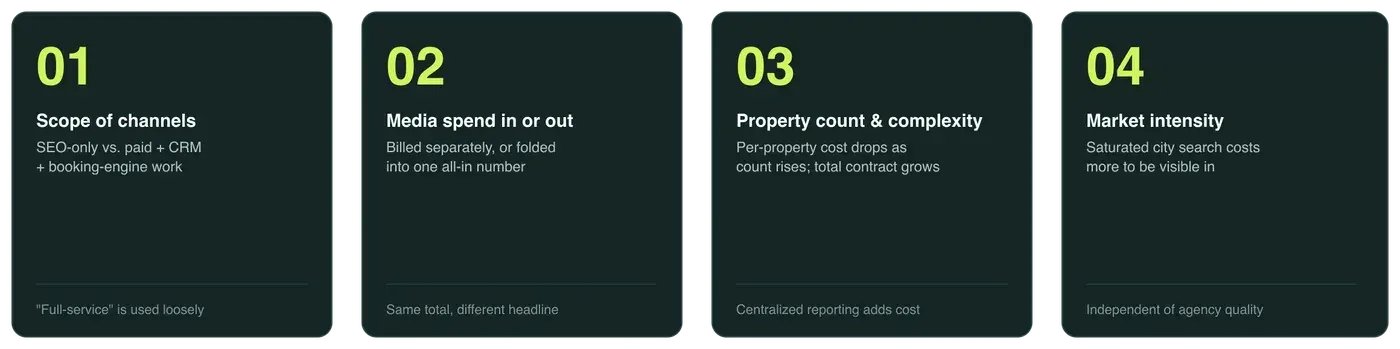
Four variables explain most of the spread between a €1,500-a-month independent-hotel retainer and a €15,000-a-month multi-property group contract, more than any difference in agency quality:
Scope of channels included. A quote covering SEO and content only will always look cheaper than one that also includes paid media management, email/CRM, and booking-engine conversion work — because it is doing less. Ask explicitly which of the service categories are included versus billed separately, since “full-service” is used loosely enough to mean almost anything.
Whether media spend sits inside or outside the fee. Some agencies quote a management fee on top of a media budget the hotel pays directly to Google or Meta. Others fold media spend into a single number. A €3,000 retainer with a separate €2,000 ad budget and a €5,000 all-in retainer covering the same ad spend are the same total cost, but only one of those numbers is the whole picture at first glance.
Property count and complexity. A single independent property with one PMS and one channel mix is a fundamentally different scope than a five-property group needing centralized reporting, brand consistency across properties, and coordination with multiple general managers. Per-property pricing usually drops as property count rises, but total contract value rises with it.
Market and competitive intensity. A city hotel competing in a saturated paid-search market for its category will need a larger paid media budget to be visible than a rural or resort property with less direct competition for its core search terms, independent of how good either agency’s work is.
Red flags worth checking before signing
A handful of patterns in a pricing proposal are worth a direct question before signing, regardless of which model is on offer:
- No breakdown by service category. A single bundled number with no itemization makes it impossible to tell what happens to the price if one service is dropped, or to benchmark any individual line against a specialist quote.
- Ambiguous definition of “revenue influenced.” In a percentage-of-revenue model, ask for the exact attribution methodology in writing. A vague answer here is the single biggest source of billing disputes six months into a contract.
- No mention of the booking engine. A pricing proposal that covers traffic generation but never mentions booking-engine conversion work is pricing half a funnel and presenting it as the whole thing.
- Long minimum terms with no defined exit metric. A twelve-month minimum commitment is common and not inherently a problem, but it should come with a written definition of what “not working” looks like at the six-month mark, not just a renewal date.
- Pricing that doesn’t scale with anything. A flat fee that stays identical whether the property has 20 rooms or 200 rooms, or whether the market is saturated or not, usually signals a templated service rather than one actually scoped to the property.
What Resaco recommends
Resaco publishes its prices. Our three packages start at €2,500 a month, as a fixed fee with no percentage of ad spend and a 60-day cancellation. The full breakdown is on the pricing page. Scope still moves the real answer: property count, market saturation and how much media spend sits outside the fee. So put every proposal you compare into the same format first: same channels included, same treatment of media spend, same attribution definition. That is where the real price difference usually hides. The headline monthly figure rarely shows it.
For hotels trying to work out what should actually be in scope before pricing it, the fuller breakdown of service categories is worth reading first: Hotel Marketing Services: What Should Actually Be on the Menu. And for owners who want the structured, vendor-neutral process for picking an agency at all — pricing is only one part of that decision — see how to choose a hotel digital marketing agency.
Frequently asked questions
Is a percentage-of-revenue model more expensive than a flat retainer?
Not inherently — it depends on the base it’s calculated against and how the agency defines “influenced” revenue. A percentage model can cost less than a flat retainer for a slower season and more during a strong one, which is the point of the model, not a flaw in it.
Should paid media spend be included in the agency’s quoted fee?
Either structure is workable as long as it’s clear which one you’re looking at. The mistake is comparing a management-fee-only quote against an all-in quote as if they were the same number.
What’s a reasonable minimum contract length?
Six to twelve months is typical, largely because SEO and content work take months to show results and a shorter term makes it hard to judge whether the work is actually failing or just still ramping up. The term length matters less than having a defined checkpoint inside it.
Does a cheaper quote always mean less service?
Usually, but not always — sometimes it means a narrower scope, and sometimes it means an agency that’s simply priced aggressively to win the account. The scope breakdown, not the headline number, is what tells you which one you’re looking at.
Related reading: Hotel Marketing Services, Hotel Marketing Plan: The Framework, Not the Budget Numbers, How to Choose a Hotel Digital Marketing Agency