


A 30-room property on a Croatian island spent two years pitching itself cold to travel editors, one templated email at a time, with almost nothing to show for it. Then a new PR contact organized a single, carefully hosted press trip for one writer from a well-known glossy travel title, built around the property’s actual story rather than a generic press release, and that one feature ran for years afterward as the first search result a prospective guest saw when researching the destination. The difference wasn’t budget. It was that someone finally treated the relationship, and the story, as the actual product being pitched.
That gap between cold outreach and earned coverage that compounds for years is the whole case for taking luxury hotel PR seriously as its own discipline, separate from paid channel strategy and separate from the deeper brand-positioning work of choosing the right agency in the first place.
The response-rate problem most properties don’t see coming
Travel journalists are pitched constantly, and the numbers behind that are worse than most hoteliers assume. Newspress’s 2026 travel media visibility report found journalist pitch response rates at a historic low, with only around 3% of pitches resulting in coverage. A property sending generic press releases into that environment is competing in a channel where the overwhelming majority of effort produces nothing, which is exactly why relationship-built access outperforms volume-based pitching at the luxury tier specifically: an editor who already trusts a specific PR contact opens that email differently than one from an unfamiliar sender.
- 3% of travel-journalist pitches result in coverage
- 97% go nowhere at all
- 1–3yr for relationship-built PR to compound into reliable coverage
Source: Newspress, 2026 Travel Media Visibility Report
This is the practical reason luxury hotel PR looks less like a press-release calendar and more like account management: a small number of real relationships, maintained over years, doing more work than a large mailing list ever will.
Press trips are the actual mechanism, and most are wasted
The media familiarization trip, or FAM trip, remains one of the more reliable ways to generate genuine coverage, because it gives a writer a first-hand story rather than a secondhand press kit. But a press trip built around a generic property tour, the same itinerary every visiting journalist gets, tends to produce generic coverage, if it produces anything at all.
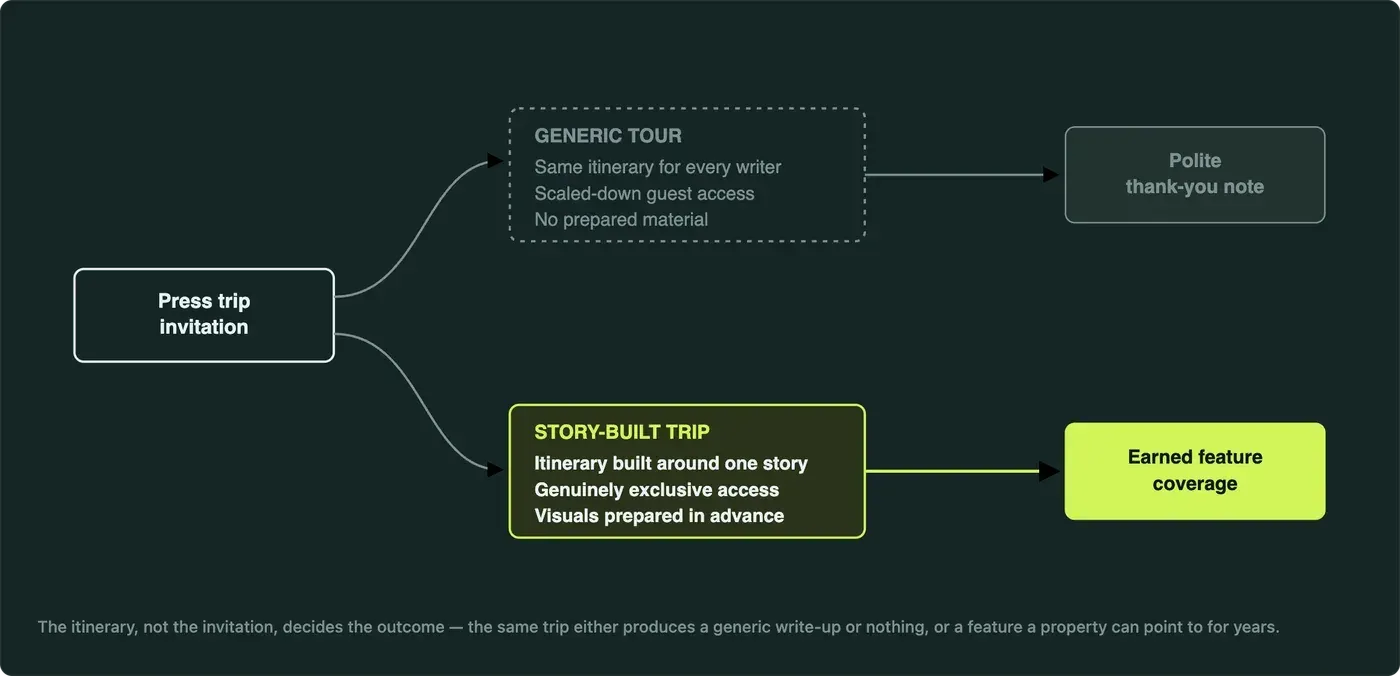
What separates a press trip that earns a feature from one that earns a polite thank-you note:
- The itinerary is built around a specific story, not a room tour. A writer covering wellness travel needs a different three days on property than one covering design or food.
- Access is genuinely exclusive, not a scaled-down version of what any paying guest gets. A behind-the-scenes moment, a conversation with the person who actually designed the property, or an experience not sold to guests at all gives a writer something to write about that isn’t already on the website.
- The visual and narrative material is prepared in advance. Journalists and the photographers or videographers who sometimes accompany them need something visually distinct to work with, not just a well-lit lobby.
A press trip is an investment in one relationship at a time, not a volume tactic, and treating it like a volume tactic (inviting every journalist who asks, running the same script for each) is the most common way properties spend real money on PR and get little back.
The editorial ecosystem is smaller and more specific than it looks
Luxury travel coverage concentrates around a genuinely short list of outlets that matter disproportionately to the audience a luxury property is trying to reach: Condé Nast Traveler, Forbes Travel Guide, Robb Report, Departures, Tatler, and the Financial Times’ How To Spend It, among a handful of others. A PR effort that treats every travel publication as equally valuable spreads relationship-building effort across outlets that don’t move the needle for this specific guest, while under-investing in the small number that actually do.
Knowing which of those outlets covers a specific property’s actual category (design-forward independent hotels, wellness-focused resorts, family-owned heritage properties) matters more than chasing the biggest name on the list. A feature in a mid-tier outlet whose readership matches the guest profile precisely often converts more real interest than a passing mention in a larger publication whose readers aren’t looking for this kind of stay at all.
Awards and “best of” lists are no longer just vanity metrics
Hotel awards used to function mostly as a credibility signal: a framed certificate, a line on the website, a talking point for the sales team. That’s changing. Condé Nast Traveler’s Gold List, Hot List, and Readers’ Choice Awards now feed into a “Triple Crown” recognition for properties that appear across all three over time, explicitly rewarding sustained brand strength rather than a single good year. More significantly for direct bookings specifically, Condé Nast Traveler has begun building booking functionality directly into its editorial rankings, meaning an award placement is starting to sit one click away from an actual reservation rather than just a mention a reader has to act on separately later.
That shift matters for how a property should think about awards submissions: they’re no longer purely reputational. A well-placed award increasingly functions as a distribution channel in its own right, which makes the submission and campaign work behind winning one worth real budget and real planning time, not an afterthought handled the week a deadline is due.
In-house PR versus an agency: the real trade-off
Properties choosing between building an in-house PR function and hiring a specialist agency are really choosing between two different kinds of asset. An in-house person builds deep, specific knowledge of one property’s story and can respond immediately to a same-day request from a journalist. A specialist agency, such as the firms known for hospitality and travel PR specifically, brings existing relationships with editors that took years to build and that a single property, on its own, would need years to replicate from zero.
Many properties end up with a hybrid: an in-house contact who knows the property intimately, working alongside an agency or freelance specialist whose actual asset is the relationship network. The mistake to avoid is assuming either one substitutes fully for the other — an in-house person without editorial relationships is limited to reactive requests, and an agency without deep property knowledge produces pitches that read as generic no matter how good their media list is.
What Resaco recommends
Resaco doesn’t run PR campaigns, so this isn’t a pitch for adding PR to a services list. What’s worth being clear-eyed about is where PR actually sits relative to the rest of a luxury property’s marketing: it builds credibility and demand at the top of the funnel, but it does not replace the work of actually converting that attention into a booking. A feature that sends a wave of qualified, high-intent visitors to a website with a slow booking engine or a channel strategy that pushes them toward an OTA listing instead of a direct reservation is earned attention that leaks straight into someone else’s commission. PR and direct-booking conversion have to be built to work together, not run as separate projects that happen to share a marketing budget.
Frequently asked questions
Is luxury hotel PR worth it for a small independent property, or only for large brands?
It’s arguably more valuable for a small independent property, since an independent hotel doesn’t have a parent brand’s existing media relationships or awareness to draw on. A well-run PR effort is often the fastest way for an unbranded property to reach the same affluent audience a chain competitor accesses through brand recognition alone.
How long does it take to see results from luxury hotel PR?
Longer than most paid channels. Relationship-built PR compounds over one to three years rather than producing an immediate spike, since it depends on editors coming to trust a property and its contact over repeated interactions, not a single successful pitch.
Do hotel awards actually influence booking decisions, or are they mostly for the property’s own marketing?
Both, increasingly. Awards have always supported a property’s own marketing and sales conversations, but platforms like Condé Nast Traveler are now building direct booking functionality around their rankings, which means a well-placed award can influence a booking decision more directly than it used to.
Should a luxury property pitch every travel journalist who reaches out?
No. Response quality matters more than volume, and a property that says yes to every request, including ones that don’t match its actual guest profile or story, dilutes the time available for the handful of relationships that produce real coverage.
Related reading: Luxury Marketing Agency, Luxury Hotel Agency: How to Actually Evaluate the Finalists, Golf Resort Marketing